Last Updated: October 8, 2026
- How to Choose a Mixing Glass: 6 Criteria That Matter for Stirred Cocktails
- Spec Comparison: Popular Mixing Glasses for Home Bars
- Best Pick by Situation: Decision Matrix
- Worked Calculation: How Much Working Room Do You Actually Need?
- Durability and Ownership Realities
- Do You Need a Mixing Glass With a Strainer Included?
- FAQ
The best cocktail mixing glasses for most home bars are 18 oz seamless crystal glasses like the Cocktail Kingdom Yarai and Viski Yarai-style mixing glasses, because they hold a double stirred cocktail with ample room for stirring, pour cleanly without dripping, and remain stable on the bar.
Quick answer: For most people in 2026, the best cocktail mixing glasses for home bars is the Cocktail Kingdom Yarai Mixing Glass — our #1 rated choice. See the full ranked comparison, alternatives and buying advice below.
How to Choose a Mixing Glass: 6 Criteria That Matter for Stirred Cocktails
A mixing glass is not just a large glass. For stirred drinks like a Negroni, Manhattan, or Martini, it needs to chill quickly, allow a smooth stir, and pour without aerating the drink. Here’s what to evaluate before you buy.

Hiware Professional 24 Oz Cocktail Mixing Glass, Thick Bottom Seamless Crystal Mixing Glass
Included for 'Best Cocktail Mixing Glasses for Home Bars' because the listing specifies Thick Bottom Seamless Crystal Mixing Glass, details this guide uses to compare options.
View on Amazon
Barillio 24 Oz Crystal Cocktail Mixing Glass | Seamless Lead-Free Crystal, Weighted Base Stirring Pitcher
Included for 'Best Cocktail Mixing Glasses for Home Bars' because the listing specifies Seamless Lead-Free Crystal and Weighted Base Stirring Pitcher, details this guide uses to compare options.
View on Amazon
KITESSENSU Bar Mixing Glass, Seamless Pitcher for Stirred Cocktails with Weighted Bottom, Old Fashioned Bartender Accessory and Tool - 18oz 530ml
Included for 'Best Cocktail Mixing Glasses for Home Bars' because the listing specifies Seamless Pitcher for Stirred Cocktails with Weighted Bottom and Old Fashioned Bartender Accessory and Tool, details this guide uses to compare options.
View on Amazon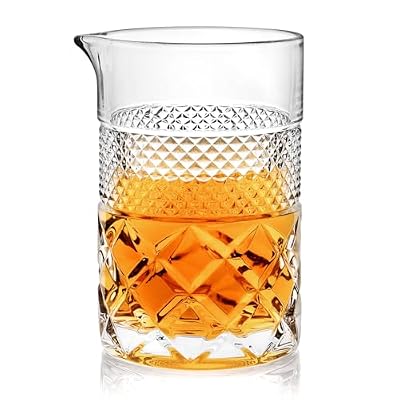
Paysky Cocktail Mixing Glass, 22oz Crystal Pitcher Thick Base Design Bartending Glasses - Barware Essentials
Included for 'Best Cocktail Mixing Glasses for Home Bars' because the listing specifies 22oz Crystal Pitcher Thick Base Design Bartending Glasses and Barware Essentials, details this guide uses to compare options.
View on Amazon1. Capacity
Capacity determines whether you can properly stir without sloshing and whether you can batch two drinks at once.
- 13-16 oz (375-475 ml): Compact and easy to store, but tight for a large-format cube and a 3-4 oz pour plus ice. Best for single cocktails only.
- 17-19 oz (500-550 ml): The sweet spot for home use. Fits 8-10 oz of ice plus 4-6 oz of liquid, leaving headroom for a fast, circular stir.
- 20 oz+ (600 ml+): Professional size for making two cocktails at once. Heavier, requires more ice, and can feel oversized for single-drink mixing.
2. Pouring Spout
A poorly cut spout causes dripping and breaks the silkiness of a stirred cocktail.
- Pinched lip spout: Found on classic Yarai pattern glasses. Creates a narrow, controlled stream and works perfectly with a Hawthorne or Julep strainer.
- Wide V-spout: Pours faster but can dribble if the glass walls are thick. Common on thicker, machine-made glasses.
- No spout / beaker style: Used on lab-style mixing beakers. Requires a strainer to pour cleanly and offers less control when free-pouring.
3. Wall Thickness and Weight
Wall thickness affects thermal control and feel in the hand. Thinner crystal chills faster and gives better clarity to see dilution, while thicker soda-lime glass retains cold longer but adds weight.
- Thin (1.8-2.5 mm): Lightweight, elegant, fast chilling. More fragile if knocked.
- Medium (2.5-3.5 mm): Balanced durability and thermal performance. The most common for home bars.
- Thick (3.5-5 mm): Very durable and stable, but slower to chill and can mute the stirring feel.
4. Stability and Base Design
A wide, weighted base prevents tipping while you stir vigorously. Look for a base diameter of at least 3 inches (76 mm) and a low center of gravity. Glasses with a narrow base and tall profile look elegant but will wobble when stirring with one hand.
5. Strainer Compatibility
Most mixing glasses are designed for a Julep strainer, which sits inside the glass, or a Hawthorne strainer. Standard Yarai glasses with an inner diameter of 3.5-3.75 inches (89-95 mm) fit both types without jamming. If the rim is too narrow, a Hawthorne’s spring will sit too high and leak; if too wide, a Julep strainer will fall in.
6. Material
- Lead-free crystal: Brilliant clarity, thin walls, hand-cut patterns like the Yarai diamond cut improve grip. Dishwasher safe in most cases but hand washing preserves pattern.
- Soda-lime glass: Heavier, more affordable, highly durable. Slightly cloudy compared to crystal and often has thicker walls.
- Borosilicate glass: Very thin, lightweight, thermal-shock resistant. Used for beaker-style mixing glasses. Less traditional in feel and can be slippery when wet.
Spec Comparison: Popular Mixing Glasses for Home Bars
These models are widely available in 2026 and represent the main styles you will encounter. All capacities are to the brim; working capacity is typically 2-3 oz less.
| Model | Material | Capacity | Height / Diameter | Weight | Wall Thickness | Spout Type |
|---|---|---|---|---|---|---|
| Cocktail Kingdom Yarai Mixing Glass | Lead-free crystal, hand-cut | 18 oz / 550 ml | 4.25 in / 3.6 in (108 / 92 mm) | 1.4 lb / 635 g | 2.2 mm | Pinched lip |
| Viski Yarai Mixing Glass | Lead-free crystal | 18 oz / 550 ml | 4.1 in / 3.7 in (104 / 94 mm) | 1.3 lb / 590 g | 2.4 mm | Pinched lip |
| Crafthouse by Fortessa Mixing Glass | Lead-free crystal | 17 oz / 500 ml | 4.0 in / 3.5 in (102 / 89 mm) | 1.2 lb / 544 g | 3.0 mm | Wide V-spout |
| Barfly Mixology Gear Beaker | Soda-lime glass | 17.5 oz / 520 ml | 4.5 in / 3.4 in (114 / 86 mm) | 1.1 lb / 498 g | 3.8 mm | No spout (straight beaker) |
| Riedel Mixing Glass | Lead-free crystal | 19.5 oz / 580 ml | 4.6 in / 3.8 in (117 / 97 mm) | 1.5 lb / 680 g | 2.0 mm | Pinched lip |
| Libbey 16 oz Mixing Glass | Soda-lime glass | 16 oz / 475 ml | 3.9 in / 3.5 in (99 / 89 mm) | 1.0 lb / 453 g | 4.2 mm | Wide V-spout |
Best Pick by Situation: Decision Matrix
Use your space, budget, and how you stir to narrow the choice quickly.
| Your Situation | Best Type | Why |
|---|---|---|
| First mixing glass, limited budget, want durability | Thick soda-lime glass like Libbey or Barfly (16-17.5 oz) | Lowest price range, survives bumps, fits standard strainers, easy to replace. General market range: $15-$30. |
| Make 1-2 stirred cocktails nightly, want balance of feel and stability | 18 oz Yarai crystal (Cocktail Kingdom or Viski) | Ideal working volume for one large or two small drinks, weighted base, thin walls for fast chill. General market range: $30-$50. |
| Design-focused home bar, serve guests | Riedel or Crafthouse by Fortessa crystal | Highest clarity and elegant pattern, more presentation value. Slightly larger or heavier. General market range: $35-$60. |
| Small apartment / limited storage | 17 oz low-profile crystal or beaker style | Shorter height fits in cabinets, under 1.2 lb is easier to handle and store with a bar spoon. |
| Batch two cocktails at once | 19-20 oz or larger Yarai | Extra headroom prevents overflow when stirring 6-8 oz of total liquid plus large ice. |
Worked Calculation: How Much Working Room Do You Actually Need?
A common mistake is buying a glass that is too small. Here is the math for a standard stirred serve:
- Liquid volume: 3.0 – 4.5 oz (90-135 ml) for a Manhattan, Negroni, or Martini
- Ice: 6-8 oz (170-225 g) of large cubes or 1 large cube plus cracked ice
- Ice displaces about 50% of its weight in volume, so 7 oz of ice needs roughly 3.5 oz of space plus headroom to stir
- Total minimum working volume: 6.5 – 8.0 oz before stirring, plus 2.0 oz of clearance to keep liquid from sloshing over the rim
That means a 13 oz glass leaves almost no margin once ice is added. An 18 oz glass gives you 10 oz of safe working volume, which is why it is the standard recommendation for home use. If you routinely stir two drinks together (7-9 oz liquid), you should target at least 19 oz to brim.
Durability and Ownership Realities
Mixing glasses rarely break mid-stir, but they do wear in predictable ways.
- What chips first: The spout tip and the base edge. A pinched spout is thinner than the surrounding rim and will chip if it taps a metal strainer or faucet. Store it away from shakers and tins.
- Pattern wear: Hand-cut Yarai diamonds provide grip when dry, but can trap oils and become cloudy. The pattern does not fade, but hard water deposits will fill the cuts if air-dried.
- Thermal shock: Crystal and soda-lime glass can crack if you pour boiling water to temper then immediately add ice. Rinse with cool water between hot and cold steps.
- Cleaning: Most crystal mixing glasses are technically dishwasher safe, but hand washing with warm soapy water and a soft sponge preserves clarity. Avoid abrasive pads on the exterior pattern. Dry immediately with a lint-free towel to prevent spots.
- Common mistakes: Stirring with a thin teaspoon instead of a long bar spoon scratches the interior base; using crushed ice instead of large cubes over-dilutes and forces you to stir longer; overfilling above 75% of brim capacity guarantees spills during the pour.
Do You Need a Mixing Glass With a Strainer Included?
Sets that bundle a Hawthorne or Julep strainer seem convenient, but bundled strainers are often a generic size. A loose-fitting Julep strainer will not seal and will dump ice chips into the coupe. It is usually better to buy the glass and strainer separately, testing that the strainer rim sits flush against the inner wall. If you already own a Hawthorne strainer for shaking tins, it will work with any 17-19 oz mixing glass with a 3.5-3.8 inch opening.
FAQ
Can I use a pint glass instead of a mixing glass?
Yes, a 16 oz pint glass will chill and stir a single drink, but it lacks a spout, has thinner walls that get uncomfortably cold, and often has a narrower base that is less stable. A dedicated mixing glass pours cleaner and gives you more control over dilution.
Is thicker glass better for keeping drinks cold?
Thicker glass insulates slightly longer, but the difference is less than 30 seconds compared to crystal once the glass is pre-chilled. Pre-chilling the glass in the freezer for 10 minutes or stirring with ice for 5 seconds before adding ingredients has a far larger effect than wall thickness.
What size bar spoon should I use with these glasses?
A 12-inch (30 cm) bar spoon with a twisted shaft is ideal for 17-19 oz glasses. It reaches the bottom without your hand entering the glass and the twist helps guide a smooth, circular stir along the wall.
Ready to decide? Our #1 pick for 2026 is the Cocktail Kingdom Yarai Mixing Glass.
Live price & availability on Amazon.
Related Reviews & Guides


Best Lounge Chair Cushions in 2026: How the Top Models Compare

Best Pizza Nearby in 2026: What to Know Before You Buy