Last Updated: November 23, 2026
The best aquarium sponge filters for shrimp tanks are the Hygger Double Sponge Filter in small for most colonies, the AQUANEAT Bio Sponge Filter in middle for a classic single-sponge setup, the hygger HG225 cylinder for nano tanks, the AQUANEAT 4-Pack Double Bio Sponge Filter for breeding racks, and the Lustar Hydro-Sponge V for large colonies. Every pick is air-driven, with no intake slot a shrimplet can enter.
A shrimp tank fails on filtration in two ways: a power filter pulls newborn shrimplets through its intake, or the flow pushes berried females around the tank. A sponge filter avoids both. Air rising through the uplift tube draws water gently through the foam, bacteria colonize the foam, and shrimp graze that surface all day. All five need a separate air pump and airline tubing.
As an Amazon Associate, we earn from qualifying purchases.
Table of Contents
- How to Choose a Sponge Filter for Shrimp
- Hygger Double Sponge Filter, Small (HG256)
- AQUANEAT Bio Sponge Filter, Middle (SF-A001)
- hygger HG225 Cylinder Sponge Filter
- AQUANEAT 4-Pack Double Bio Sponge Filter (SF-A010)
- Lustar Hydro-Sponge V Filter (HS950)
- Who Should Skip
- Frequently Asked Questions
- Conclusion
- Product and ASIN Reference
How to Choose a Sponge Filter for Shrimp
Start with shrimplet safety, the whole point of a sponge filter. Newborn shrimp measure about 2 to 3 millimeters at hatching, so any intake slot or coarse opening is a risk. Every filter here draws water through foam only, with no exposed intake. Fine foam suits a breeding tank, since it traps small particles and gives biofilm more surface.
Treat the tank rating as a ceiling. A filter rated for 20 gallons works well in a 10-gallon shrimp tank, but runs near its limit in a fully stocked 20-gallon tank. When in doubt, size up, or run two smaller filters at opposite ends so one can be rinsed while the other keeps working.
Every air-driven sponge filter needs a separate air pump, airline tubing, and a check valve to stop water siphoning back during a power cut. Choose a pump rated for the tank depth, since a deep tank needs more pressure to push air down the tube. A control valve on the airline lets the flow be turned down for a berried female or newborns.
Hygger Double Sponge Filter, Small (HG256)
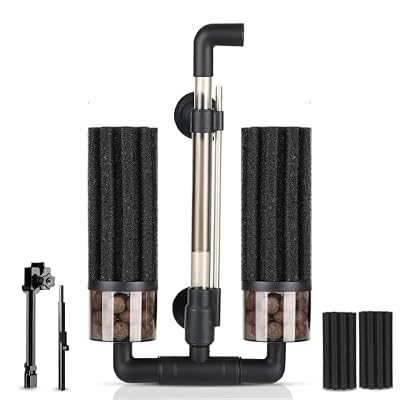
The Hygger Double Sponge Filter in small is the best overall pick for a shrimp tank between 10 and 40 gallons. Two fine foam columns sit side by side, each holding a container for ceramic media, combining trapping, biological filtration, and aeration in one unit. The box also includes bioceramic balls and two spare biochemical sponges, so a worn sponge can be swapped without a separate order.
The fine foam gives bacteria a large surface and shrimp plenty of biofilm to graze, and the two sponges detach separately, so one can be rinsed while the other keeps working. An extendable clip holds the unit to the glass, and the outlet tube extends and rotates, so the bubble stream can be aimed above or below the waterline. It runs on a standard 4-millimeter airline in fresh water and salt water; the air pump is sold separately. This is the upgraded HG256 line, a separate listing from the older medium double-sponge filter, so check that the box says HG256.
| Spec | Detail |
|---|---|
| Brand | Hygger |
| Model | HG256, small |
| Tank size | 10 to 40 gallons |
| Dimensions | 6 inches wide x 9 to 14 inches tall, adjustable |
| Weight | 12.6 ounces |
| Foam | Two fine sponges, plus 2 spares |
| Media | Bioceramic balls included |
| Air pump | Not included, 4 mm airline |
| ASIN | B0FJCZLDJ8 |
| Tier | Mid-range |
AQUANEAT Bio Sponge Filter, Middle (SF-A001)

The AQUANEAT Bio Sponge Filter in middle is the classic single-sponge design, and the best budget pick for a shrimp tank up to 20 gallons. One cylindrical sponge sits on a weighted base, and an air infusion chamber makes fine bubbles that raise oxygen levels. The listing names shrimp among the stock it suits, and the gentle current will not push shrimplets or berried females around the tank.
The design stays simple: one piece to rinse, one airline to connect, nothing to assemble beyond pushing the tube into place. Breeders trust this shape with fry and shrimp colonies, since the soft foam will not pull small shrimp through. At 3 inches across and 6.5 inches tall, it takes a modest footprint in a 10-gallon tank. The air pump is sold separately. This middle size sits between the small 3-pack and the large single sponge, so check that the listing says middle up to 20 gallons.
| Spec | Detail |
|---|---|
| Brand | AQUANEAT |
| Model | SF-A001, middle |
| Tank size | Up to 20 gallons |
| Dimensions | 3 inches diameter x 6.5 inches high |
| Weight | 4.9 ounces |
| Filtration | Mechanical and biological, air infusion chamber |
| Included | 1 sponge filter |
| Air pump | Not included |
| ASIN | B078Q29JT4 |
| Tier | Budget |
hygger HG225 Cylinder Sponge Filter

The hygger HG225 is the nano pick, a short cylinder sponge filter for shrimp cubes and breeding boxes from 3 to 30 gallons. Its compact shape fits behind moss, under driftwood, or in a 5-gallon corner without crowding the shrimp. The foam gives the colony a grazing area, and the gentle bubble stream keeps the water oxygenated without disturbing a berried female.
Two sizes share the HG225 listing: the small suits tanks below 40 centimeters deep, the medium below 60 centimeters. The body uses ABS and metal with filter cotton, and the sponge detaches for rinsing in removed tank water. For a single nano shrimp tank, this is the smallest footprint in the guide.
| Spec | Detail |
|---|---|
| Brand | Hygger |
| Model | HG225 |
| Tank size | 3 to 30 gallons |
| Dimensions | Small 6 x 6 x 8.5 cm; Medium 6 x 6 x 13.5 cm |
| Weight | 7 ounces |
| Material | ABS, metal, filter cotton |
| Air pump | Not included |
| ASIN | B0F52TXPTW |
| Tier | Budget |
AQUANEAT 4-Pack Double Bio Sponge Filter (SF-A010)

The AQUANEAT 4-Pack Double Bio Sponge Filter is the breeding-rack pick, four double-sponge filters in one box for keepers running several shrimp tanks at once. Each filter has two sponge columns, so one box covers four nano tanks, or two larger tanks with a filter at each end. The listing names shrimp among the stock it suits, and the double sponge gives each tank more foam surface for bacteria and biofilm than a single sponge of the same footprint.
Each unit is rated for tanks up to 55 gallons, though the size suits shrimp tanks far smaller. The four filters share the same model number, so spares and replacements stay simple across a rack. Rinse one sponge at a time, and keep a spare filter cycled in a mature tank so a new shrimp setup can start with seeded foam. The air pump and airline are sold separately.
| Spec | Detail |
|---|---|
| Brand | AQUANEAT |
| Model | SF-A010, 4-pack |
| Tank size | Up to 55 gallons each |
| Dimensions | 6.5 x 2.4 x 9.5 inches overall; sponge 2.4 inches diameter x 4.7 inches high |
| Weight | 9.1 ounces |
| Included | 4 double-sponge filters |
| Air pump | Not included |
| ASIN | B07G44NM8P |
| Tier | Mid-range |
Lustar Hydro-Sponge V Filter (HS950)

The Lustar Hydro-Sponge V is the premium pick, the classic large sponge filter for a big shrimp colony or a breeding system up to 125 gallons. Its large foam block gives bacteria far more surface area than the smaller picks here, and the base raises the sponge off the tank floor. The uplift tube accepts a powerhead connection as well as an air pump, so the flow can be raised for a large system or kept gentle for shrimp.
It needs real space inside the tank and suits a large colony tank rather than a nano cube. In a large shrimp system, the dense foam traps fine particles that lighter sponges pass, and the soft material squeezes clean easily in removed tank water. It provides biological and chemical filtration and works in fresh water. An air pump, airline tubing, and any powerhead are sold separately.
| Spec | Detail |
|---|---|
| Brand | Lustar, Aquarium Technology Inc. |
| Model | Hydro-Sponge V, HS950 |
| Tank size | Up to 125 gallons |
| Dimensions | 7 x 6 x 6 inches |
| Weight | 10.41 ounces |
| Features | Raised base, powerhead connection, uplift tube |
| Air pump | Not included |
| ASIN | B0002602SM |
| Tier | Premium |
Who Should Skip
Skip a sponge filter as the only filter if the tank holds large, messy fish alongside shrimp, since the foam clogs quickly. A hang-on-back or canister filter with a sponge prefilter over the intake moves more water and holds more media, and a sponge filter works better as a second filter there.
Skip the Hydro-Sponge V in a nano tank, and skip the HG225 cylinder in a tank deeper than 60 centimeters. Skip any sponge filter if there is no air pump yet, and budget for one plus a check valve, since none of the five picks includes a pump. Prefilter sponge covers guard an intake, but they do not filter a tank on their own.
Frequently Asked Questions
Are sponge filters safe for baby shrimp?
Yes, and that is their main strength. A sponge filter has no intake slot, so newborn shrimplets measuring 2 to 3 millimeters cannot be pulled through it the way a power filter can pull them in. The fine foam also gives the colony biofilm to graze, a first food source for newborn shrimp. Keep the flow gentle with a control valve on the airline while the colony has newborns.
Do shrimp eat the biofilm on a sponge filter?
Yes. Shrimp graze the foam constantly, picking at biofilm and trapped particles. That is one reason to rinse gently and only when the bubble flow weakens: a hard squeeze strips the biofilm the shrimp were eating. Rinse one sponge at a time on a double-sponge filter so the colony always has a grazed surface left.
Can a sponge filter be the only filter in a shrimp tank?
Yes, for lightly stocked shrimp tanks, nano setups, and breeding tanks, where the shrimp load is small and the flow stays gentle. For a heavily stocked tank, or a tank that also holds fish, a sponge filter works best alongside a hang-on-back or canister filter with a sponge prefilter, or as a pair at opposite ends.
How often should I clean a sponge filter in a shrimp tank?
Rinse the sponge every two to four weeks, or sooner if the bubble flow weakens. Squeeze it gently in a bucket of removed tank water during a water change, and never rinse it under tap water, since chlorine kills the beneficial bacteria in the foam. Replace the sponge only when its pores stay clogged after rinsing.
Conclusion
For most shrimp colonies, choose the Hygger Double Sponge Filter in small, with ceramic media and spare sponges. For a classic single-sponge setup up to 20 gallons, choose the AQUANEAT Bio Sponge Filter in middle. For a nano cube, choose the hygger HG225 cylinder. For a breeding rack, choose the AQUANEAT 4-Pack Double Bio Sponge Filter. For a large colony up to 125 gallons, choose the Lustar Hydro-Sponge V. Match the rating to the tank, add an air pump with a check valve, and rinse in removed tank water.
Product and ASIN Reference
| Product | ASIN |
|---|---|
| Hygger Double Sponge Filter, Small (HG256) | B0FJCZLDJ8 |
| AQUANEAT Bio Sponge Filter, Middle (SF-A001) | B078Q29JT4 |
| hygger HG225 Cylinder Sponge Filter | B0F52TXPTW |
| AQUANEAT 4-Pack Double Bio Sponge Filter (SF-A010) | B07G44NM8P |
| Lustar Hydro-Sponge V Filter (HS950) | B0002602SM |
Best Bacteria Starters for Seniors: Easy Cycling Help
Best Aquarium Decorations for Goldfish: 5 Safe Picks